martes, 21 de septiembre de 2010

Hagia Sophi, Instanbul Turkey--Jessica Cardenas


Saint Sophia is finest and most famous of Byzantine architecture in the world. It is located in Istanbul, next to the Blue Mosque in the Sultan Ahmet Square of Istanbul.

Hagia Sophia was built as a Constantinian Church by the emperor Justinian I, between A.D. 532 and 537 and in it's ancient time, it represented the largest covered space in the world. It's architects were Isidore of Miletus and Anthemius of Tralles

Today Saint Sophia is neither a Church nor a Mosque but it is a museum 

 The main ground plan of the building is a rectangle, 230 feet in width and 246 feet in length. The area is covered by a central dome of 102 feet.
The main dome is carried on pendentives: (four concave triangular sections of masonry). Each pendentive is decorated with a seraphim. The weight of the dome passes through the pendentives to four massive piers at the corners, and between them the dome seems to float upon four great arches

 The modern exit from the Hagia Sophia is through the Vestibule of the Warriors,  because it is where the emperor's bodyguards waited while he worshipped. As you walk out is a mosaic of the Virgin with Constantine and Justinian:  This mosaic dates probably from the 10th century. 
 

Medieval Period..! by fernanda munguia

The medieval time of history spans a period of more than 700 years, beginning around the year 800.
A major part of medieval history were the Crusades. They were launched to defend Christianity form Islam. In total, the Crusades lasted more than 200 years.

Books of art. web. sep/21/2010
MEDIEVAL ART.
Medieval art produced from about 6th century to 15th century. Most surviving art from the this period was religious in focus, often funded by the Church, powerful ecclesiastical individuals such as bishops, communal groups such as abbeys, or wealthy secular patrons. Realism was not the primary concern of Medieval artists, they were simply trying to send a religious message, a task which demands clear iconic images instead of precisely rendered ones.

Books of art. web. sep/21/2010
Brill. web. sep/21/2010
Middle ages medieval. web. sep/21/2010

lunes, 20 de septiembre de 2010

Hagia Sophia By:Ricardo Dominguez

hagia sophia external pic

The image corresponds to the building that nowadays is  a museum called Hagia Sophia that is localized in Istanbul, Turkey.

Hagia Sophia ( night ) 

This building has a very interesting story, Constantius II inaugurated this building in 360 after Christ, the first usage of the building was to be a church, then that church was destroyed and by orders of Theodosius II rebuilt it in 532, but again it was destroyed and built again by the year 537 and was until 562 when the church passed to be the seat of the Orthodox patriarch of Constantinople, so the imperial ceremonies were presented there. 


Many years passed and after a siege Constantinople passed to be property of the Ottoman emperor Mehmet II that made it a mosque. And in 1934, the founders of Turkish Republic, Mustafa Kemal Ataturk convert it to a museum 


Ok in this church there where two things that cached my attention the first one is that how in one building we can observe the contrasts of two religions together, the Islamic and the Christianity for example in the dome there are Islamic mosaics but Christianity mosaics too.

When the transformation of the church into a mosque was interesting to me too because this changed caused the removal of altars, sacrificial vessels, bells and how I said before they covered the mosaics so if you can imagine the extreme change of the visual things of the church, after seeing these changes the masque inspired the ottomans to build their mesquites for example the blue mosque of Istanbul.

Christianity


The second thing  that for me was interesting was something called Sultan Lodge, that is in Rococo style and is like a chamber not close entirely that helped to avoid a possible assassination  of the current sultan

Sultan Lodge


Works Cited

"Hagia Sophia Facts." Lifestyle Lounge. nd. Web. 21 Sept. 2010. <http://lifestyle.iloveindia.com/lounge/hagia-sophia-facts-3676.html>.
"Hagia Sophia." Hagia Sophia. nd. Web. 21 Sept. 2010. <http://www.hagiasophia.com>.
"Hagia Sophia Pictures Images of Hagia Sophia." Turkish Culture Pics. nd. Web. 21 Sept. 2010. <http://turkishculture.blogspot.com/2005/04/hagia-sophia-pictures-images-of-hagia.html>.


Notre Dame - Manuel Gomez


Notre Dame de Paris, also known as Notre Dame Cathedral, is a Gothic, Catholic cathedral on the eastern half of the Île de la Cité in the fourth arrondissement of Paris, France. It is the cathedral of the Catholic Archdiocese of Paris: that is, it is the church that contains the cathedra (official chair), of the Archbishop of Paris, currently André Vingt-Trois. Notre Dame de Paris is widely considered one of the finest examples of French Gothic architecture in France and in Europe. It was restored and saved from destruction by Eugène Viollet-le-Duc, one of France's most famous architects. The name Notre Damemeans "Our Lady" in French, and is frequently used in the names of Catholic church buildings in Francophone countries. Notre Dame de Paris was one of the first Gothic cathedrals, and its construction spanned the Gothic period. Its sculptures and stained glass show the heavy influence of naturalism, unlike that of earlier Romanesque architecture 
Notre Dame de Paris was among the first buildings in the world to use the flying buttress (arched exterior supports). The building was not originally designed to include the flying buttresses around the choir and nave. After the construction began and the thinner walls (popularized in the Gothic style) grew ever higher, stress fractures began to occur as the walls pushed outward. In response, the cathedral's architects built supports around the outside walls, and later additions continued the pattern.


Though several organs were installed in the cathedral over time, the earliest ones were inadequate for the building. The first noteworthy organ was finished in the 18th century by the noted builder François-Henri Clicquot. Some of Clicquot's original pipework in the pedal division continues to sound from the organ today. The organ was almost completely rebuilt and expanded in the 19th century by Aristide Cavaillé-Coll.
There are five bells at Notre Dame. The great bourdon bell, Emmanuel, is located in the South Tower, weighs just over 13 tons, and is tolled to mark the hours of the day and for various occasions and services. There are four additional bells on wheels in the North Tower, which are swing chimed. These bells are rung for various services and festivals. The bells were once rung manually, but are currently rung by electric motors. When it was discovered that the size of the bells could cause the entire building to vibrate, which threatened its integrity they were taken out of use. The bells also have external hammers for tune playing from a small clavier.

HOW GREAT!!

viernes, 17 de septiembre de 2010

Notre Dame´s Cathedral -Sergio Arias-

Characteristics of Gothic Style Architecture: 

Flying Buttresses
Pinnacles
Pointed Arches
Ribbed Vaulting
Great Windows of stained glass
Twin Towers

Notre Dame de Paris means Our Lady Of Paris and is located on the eastern half of the region the Île de La Cité. And it is an active catholic church, it is the catholic Archdiocese of Paris.

Buttresses and Pinnacles
Notre Dame Cathredral is a very good example of what Gothic Architecture was since it has a lot of characterisitcs that still remain in the cathedral.

You can appreciate many of the characteristics of the architecture outside the church.
An important fact about this building is that it was the first piece of architecture to have flying buttresses and pinnacles.

- Buttresses: “Inclined bar carried on a half arch that extends (“flies”) from the upper part of a wall to a pier some distance away and carries the thrust of a roof or vault.” (Britannica).

- Pinnalces: “A pinnacle (vertical ornament of pyramidal or conical shape) often crowns the pier, adding weight and enhancing stability. The flying buttress evolved in the Gothic era from earlier simpler, hidden supports.” (Britannica).


In my opinion this a very impressive thing because instead of pillars they used a different way to support the building and you can find them outside at the sides of the church.


Ribbed Vaulting

Another interesting thing is the way the roof is constructed. Ribbed vaulting is the style. It is like arches along the roof that intersect themselves as if they were ribs conforming a perfect estabilization all the way. 


Pointed Arches
The most remarkable thing in this structure inside and outside the church are the pointed arches that make up the essential look of the gothic style.


Also, at the entrance of the church you can find twin towers that are very repesentative in this style.


South Rose Window


Location


It is very likely to find huge stained glass windows around the church. 


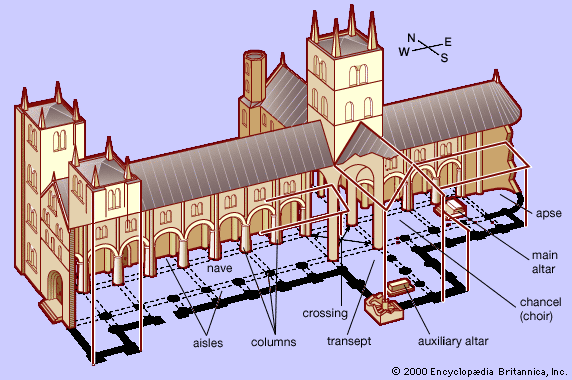
Another important detail to admire at the cathedral is the transept.

- Transept: “The area of a cruciform church lying at right angles to the principal axis. The bay at which the transept intersects the main body of the church is called the crossing.”(Britannica).


Overall I think that visiting this piece of architecture is a fanscinating experience because you have a lot of concepts of art resumed in one place. 


Bibliography
*Cathédrale Notre Dame de Paris. "The Rose Window". Diocèse de Paris. Web.15 September, 2010.

* Rib vault." Encyclopædia Britannica. 2010. Encyclopædia Britannica Online. 16 Sep. 2010 <http://www.britannica.com/EBchecked/topic/502037/rib-vault>.

* "flying buttress." Encyclopædia Britannica. 2010. Encyclopædia Britannica Online. 17 Sep. 2010 <http://www.britannica.com/EBchecked/topic/211645/flying-buttress>.

* "Transept." Encyclopædia Britannica. 2010. Encyclopædia Britannica Online. 17 Sep. 2010 <http://www.britannica.com/EBchecked/topic/602515/transept>.

* “Pinnacle." Encyclopædia Britannica. 2010. Encyclopædia Britannica Online. 17 Sep. 2010 <http://www.britannica.com/EBchecked/topic/461126/pinnacle>.

Images

*Cathedral: medieval cruciform style. Art. Encyclopædia Britannica Online. Web. 17 Sep. 2010

 *South Window. Gérard Boullay Photographies. Notre Dame´s Cathedral. Web. 17/09/10.< http://www.notredamedeparis.fr/South-Rose-Window >.

*Milan, Cathedral of. Photograph. Encyclopædia Britannica Online. Web. 17 Sep. 2010

* Vault: basic structure. Art. Encyclopædia Britannica Online. Web. 17 Sep. 2010

Notre-Dame de Paris by Daniel Castillo

Heeello, my friends. Today, I'm going to tell a brief story about a beautiful building with one of the most espectacular architectural beauty that I have ever seen in my life (I mean it). Its name is Notre Dame, and it was built in Paris a long time ago, but the details are listed below, so enjoy.

Once upon a time (On 12 October 1160), Maurice de Sully was elected bishop of Paris.
Maurice de Sully was bishop of Paris from 1160 to 1196. He provided a pastoral, theological and spiritual response to his diocese’s deep transformations by rebuilding a cathedral church dedicated to the Virgin Mary (in this case, Notre Dame, which means “our lady” in French) and making it a bishop’s church, a canon church and a baptistery.


Tradition has it that Notre-Dame’s first stone was laid in 1163 in the presence of Pope Alexander III.
This new building was constructed under the new art movement known as the gothic or ogyval style.
Built in an age of illiteracy, the cathedral retells the stories of the Bible in its portals, paintings, and stained glass.
“The first anonymous builder began with a double side aisle plan without a salient transeptm, a four story construction with tribunes, large, 32.5 meter sexpartite arches, predominantly horizontal lines, original arch work in the curved part of the deambulatory, alternating “strong” and “weak” pillars between the first and second aisles.”
The whole cathedral was constructed by many different architects, each one in different periods of time, it was an average of four architects for each century.
Notre Dame de Paris was finished in 1345. Now, it functions as a normal church where you can mass there and it has a museum with a treasury in its sacristy.


Notre Dame nowadays.
The thing that I liked the most was the South Rose window, one of the most important masterpieces of the Christian art. It is made of stained glass obviously and it represents Christ triumphant, reining over Heaven, surrounds byall his witnesses on earth. It was a gift from the king Saint Louis. It was designed by Jean de Chelles and Pierre de Montreuil.

*Information: The South Rose Window reached 12.90 meters in diameter and, if you include its bay, a total height of nearly 19 meters. It has eighty-four panes divided into four circles. The first one has twelve medallions and the second has twenty-four. A third circle is made up of quadrilobes, and the fourth circle has twenty-four trilobes medallions.
The designer’s original plans have gone undiscovered to this day. The twelve Apostles, who were originally part of the first circle, are now distributed between the two circles, amidst other figures. In the four circles, you can see Saints and Martyrs traditionally honored in France, as well as the wise virgins.

The South Rose Window

 In my opinion, I loved this cathedral. We may all know it because of certain movies or just because of general culture, but this work made me be aware of the beauty and all the effort used to create on of the most important buildings of the world. That buildings also have their own stories to tell and that they are like living entities that will long for ever in our hearts.

Dictionary:
Ø  Sexpartite:
 (of a vault) divided into six compartments by two ogives and three transverse arches, one of which crosses the ogives at the point at which they cross each other.
Ø  Aisle:
a. a longitudinal division of an interior area, as in a church, separated from the main area by an arcade or the like.
b. any of the longitudinal divisions of a church or the like.
Ø  Tribune:
A raised platform.

Bibliography:
Cathédrale Notre Dame de Paris. "Building History. Diocèse de Paris web. September 17, 2010.
Cathédrale Notre Dame de Paris. "South Rose Window". Diocèse de Paris web. September 17, 2010
Cathédrale Notre Dame de Paris. "panoramic views". Diocèse de Paris web. September 17, 2010
Discover France.net. Notre-Dame cathedral, Paris. September 17, 2010.
Great buildings web. Notre Dame Cathedral by Kevin Mathews. September 17, 2010.

miércoles, 15 de septiembre de 2010

santa sofia


Fue construida del 532 al 537, durante el mandato de Justiniano I en Constantinopla, capital del Imperio bizantino (hoy Estambul, en Turquía).

Sus arquitectos, Antemio de Tralles e Isidoro de Mileto, cubrieron el edificio, de planta casi cuadrada, con una cúpula central sobre pechinas. Ésta reposa sobre cuatro arcos, sostenidos a su vez por cuatro columnas.

a la iglesia de santa sofia se le conocia como Megale Ekklesia o mega iglesia

En su interior son dignos de admirar sus mosaicos hechos a base de vidrios de colores o transparentes sobre hojas de oro, con los que antiguamente, en la época bizantina, se representaban escenas bíblicas. Sus suelos totalmente cubiertos de alfombras orientales de distintas formas y colores, las impresionantes columnas que sostienen la cúpula, los labrados de las paredes y el ambiente que se respira, le dan ese toque casi místico que hacen de Aya Sofía el templo de la “Sabiduría Divina”. Y es que Aya Sofía (Santa Sofía) es uno de los tres títulos dedicados a Dios: Aya Sofía (Sabiduría Divina), Aya Irene ( quietud, paz) y Aya Dinamis (poder sagrado).

Casi 1.500 años después Santa Sofía está considerada como la obre cumbre del bizantino, y ha sido designada candidata a una de las Nuevas Maravillas del Mundo.  


Bibliografia

Santa Sofía: una joya bizantina entre Europa y Asia. June 6, 2007. 15/09/10. webpage

http://locuraviajes.com/blog/santa-sofia-una-joya-bizantina-entre-europa-y-asia/

santa sofia. 2000. 15/09/10. webpage
http://www.estambul-online.com/santa_sofia.htm

IGLESIA DE SANTA SOFÍA: TEMPLO DE LA SABIDURÍA DIVINA . no hay fecha. 15/09/10. webpage  http://www.portalplanetasedna.com.ar/santa_sofia.htm